

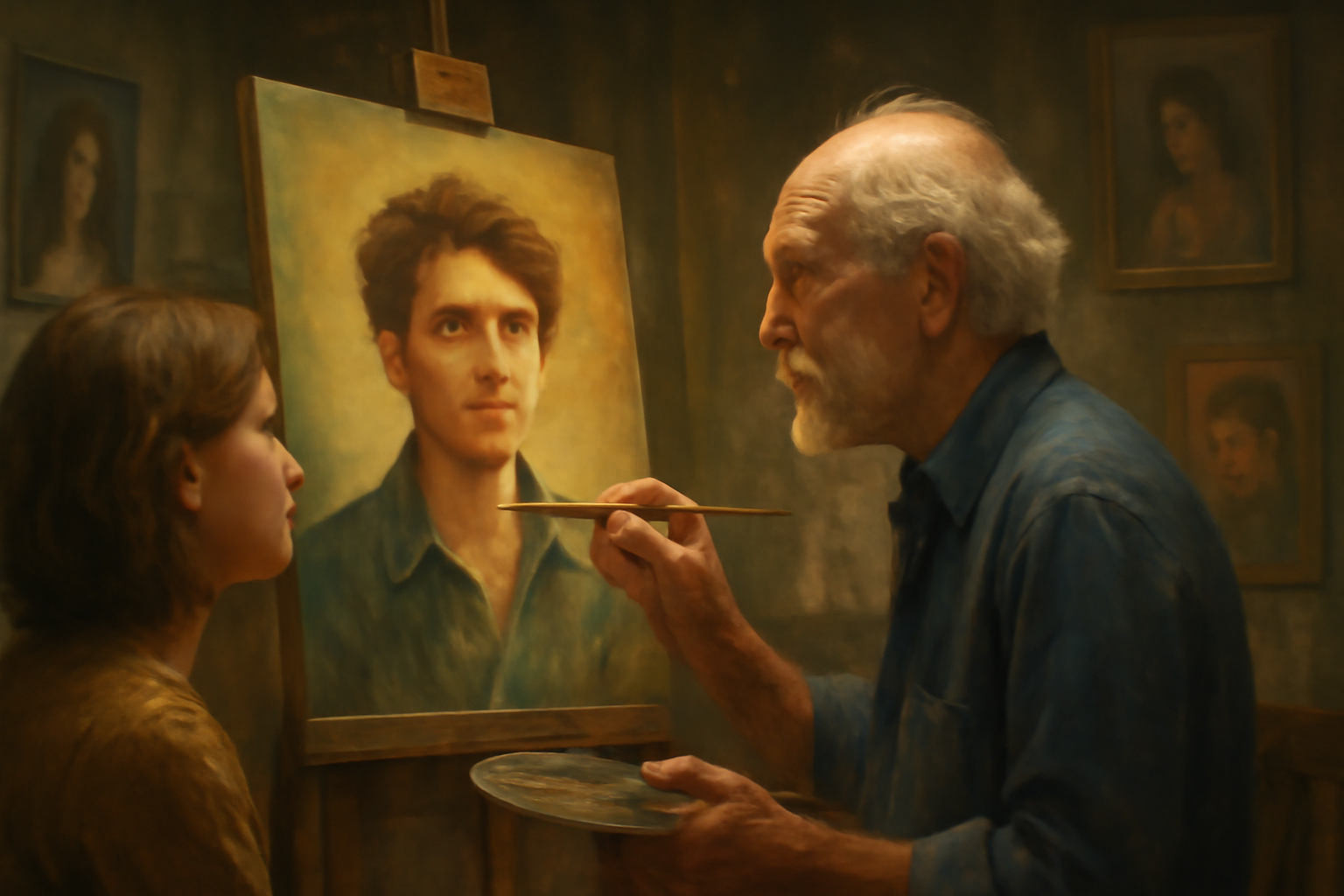
And Francis paid it willingly.
He’d lived a long, beautiful life.
He didn’t fear fading, so long as the world brightened in his place.
But then something happened that changed everything.
A girl approached him on a warm spring morning—not for a portrait, but to give him one.
She couldn’t have been older than thirteen.
She held out a canvas—small, clumsily wrapped, paint smudged on her fingers.
“I painted this,” she said shyly. “It’s for you.”
Francis unwrapped it.
And froze.
She had painted him.
Not the elderly man everyone saw.
But the man he had once been—the vibrant, joyful teenager who first picked up a brush and decided color was a language. The young adult who believed every person had something beautiful inside them. The middle-aged man who stayed kind even when life began taking things from him.
She had painted all versions of him at once.
Like she had seen the truth inside him—
the same way he saw truth inside others.
Francis stared at the portrait.
His throat tightened.
“How did you…?” he whispered.
She shrugged. “I don’t know. I just… looked.”
For the first time in decades,
someone painted him back.
And in that moment—
in that tender, miraculous moment—
the fading stopped.
Or rather,
it reversed.
Not dramatically.
Not in a blaze of rebirth.
But gently.
Like someone relighting a candle with careful hands.
Color returned to his cheeks.
Warmth returned to his palms.
Strength returned, not as youth, but as purpose.
He had spent years helping people remember themselves.
And this girl—this quiet, brilliant girl—had reminded him.
“You helped me,” she said simply. “I wanted to help you too.”
Francis wiped his eyes.
“Thank you,” he whispered. “More than you know.”
She smiled.
Shy.
Proud.
“You made me remember who I am,” she said. “It felt right to return the favor.”
That afternoon, Francis packed his easel and paints.
Not to retire.
But to move.
Not away from town.
Deeper into it.
He asked the girl—her name was Isla—if she wanted to learn.
She nodded so hard she nearly fell off the bench.
And so the magic passed on—
not by fading,
but by multiplying.
Soon, others joined.
Children. Teens. Adults who had once lost dreams of their own.
Francis taught them what no one had ever taught him:
How to see gently.
How to paint truth without wounding.
How to reveal someone without exposing them.
How to hold another person’s soul with compassion.
And as his students painted others,
the town changed.
People grew softer with themselves.
Kinder with each other.
Braver with their forgotten hopes.
Francis lived long enough to see the square filled with new painters wearing aprons splattered with colors he once mixed alone.
He lived long enough to see Isla open a tiny art shop called The Everly Studio.
He lived long enough to see people walk in looking lost,
and walk out looking found.
He lived long enough to know:
His portraits had never been the miracle.
People were.
He had only helped them look in the right direction.